 ultimate-guide
Is Motorcycle Training Worth It? A 2026 Cost-Benefit Guide
Table of Contents
- Is Motorcycle Training Worth It?
- Motorcycle Insurance Discounts for Training
- How Long Is a Motorcycle Safety Course?
- What You'll Learn in a Beginner Course
- Motorcycle Training Course Gift Cards
- Self-Taught vs. Formal Training: Pros and Cons
- Conclusion
- Frequently Asked Questions
Last Updated: October 4, 2026
Is Motorcycle Training Worth It?
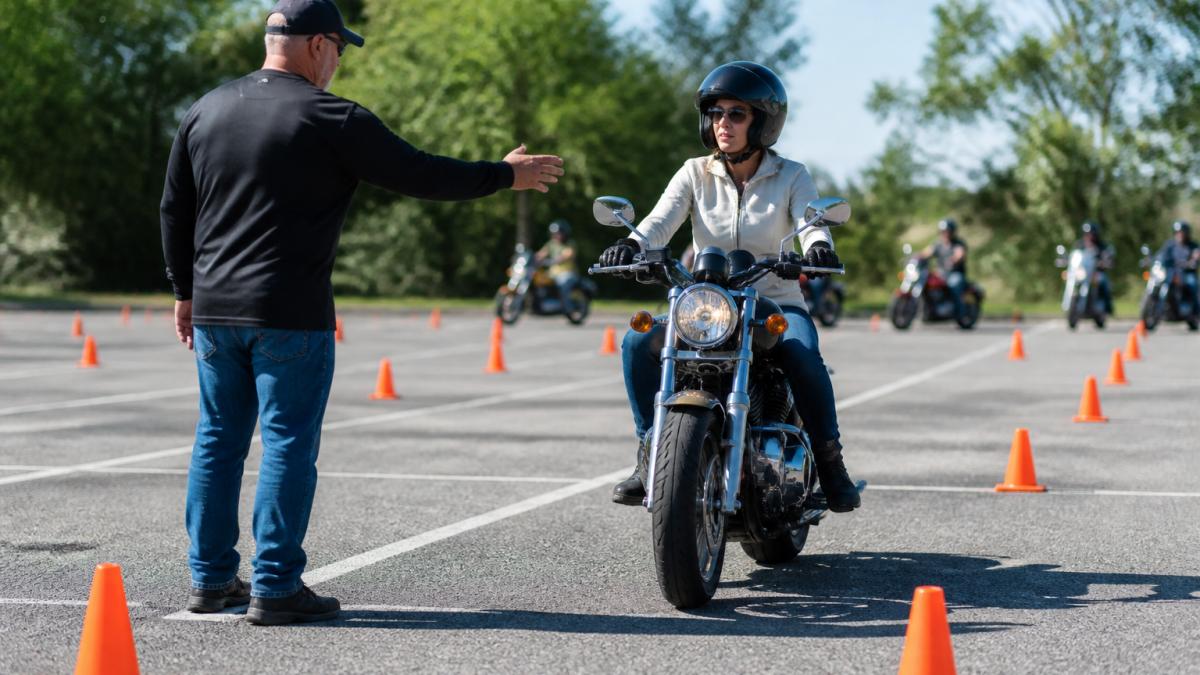
For anyone weighing whether to ride, the honest answer is that motorcycle training is worth it because it compresses months of risky trial-and-error into a structured, supervised weekend. In Florida, the state's Basic RiderCourse is the standard path to a motorcycle endorsement, and it removes the need to take a separate riding skills test at the DMV. This guide from Tampa Motorcycle Training breaks down the insurance incentives, the time commitment, and what you actually learn, so you can decide for yourself.
The stakes are not abstract. Riding a motorcycle is far less forgiving than driving a car, and the skills that keep riders upright in traffic, clutch control, emergency braking, countersteering, and hazard perception, are not instincts you're born with. They're learned. The question isn't whether training helps. It's whether you can afford to skip it.
Below, we'll show you exactly how to evaluate the value of a motorcycle training course, what it covers, and where the real return shows up.
Motorcycle Insurance Discounts for Training
Completing a recognized rider course often lowers your insurance premium, but the size and even the existence of that discount depends on three things: your carrier, your state's insurance regulations, and which course you took. A motorcycle insurance discount for training is not automatic, it's something you have to ask for and document.
Here's how the discount actually works in practice. Most major carriers that offer it fall into one of three buckets:
- Percentage reduction on liability or medical payments coverage. Common ranges cited by agents are in the 5% to 15% range, applied to specific portions of the policy rather than the whole premium.
- Flat credit or policy credit. A fixed dollar amount off the annual premium, often $25 to $75, regardless of your bike or coverage level.
- No discount at all. Some carriers simply don't recognize rider courses, especially if the course isn't on their approved list.
The course itself matters. Carriers typically recognize courses that follow the Motorcycle Safety Foundation (MSF) curriculum or a state-administered equivalent, such as a Basic RiderCourse (BRC) or Basic RiderCourse 2 (BRC2). A random weekend clinic from an unaffiliated provider usually won't qualify. If you're unsure, ask the school whether its completion card is accepted by major insurers in your state before you enroll.
State rules add another layer. Some states require insurers to offer a discount for completed rider training, while others leave it entirely to the carrier's discretion. That's why two riders with identical bikes and records can get different answers from the same insurer just by living in different states.
Beyond the premium itself, a completed course can also matter after a claim. Insurers and courts look at rider training as evidence of responsible behavior, and some carriers treat certified riders more favorably during underwriting. The financial case for a motorcycle training course rarely rests on the discount alone, but it's a real benefit that stacks on top of the safety gains.
The unique angle most guides skip: the discount is not the biggest financial lever. The bigger one is what course completion does to your licensing path. In states that waive the DMV riding skills test for course graduates, you skip a separate test appointment and the risk of failing and rebooking.
How Long Is a Motorcycle Safety Course?
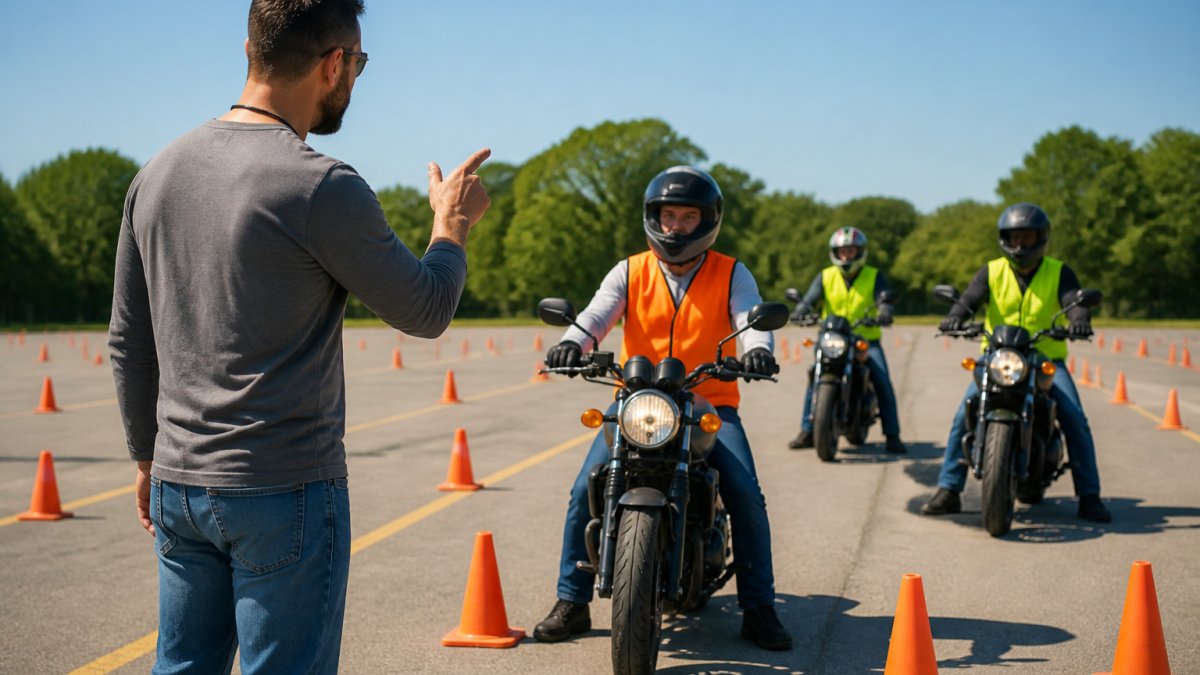
A standard beginner motorcycle safety course runs about two days, typically 15 to 20 hours total, split between classroom instruction and on-bike practice.
The two-day format is deliberate. It's long enough to build real muscle memory for clutch control, throttle management, and slow-speed maneuverability, but short enough that most people can fit it into a single weekend. You don't need weeks of practice to reach test standard. You need focused, correct repetition, which is exactly what a structured course provides.
Scheduling formats vary by provider and by state, and this is where most guides stop short:
- Weekend block. Saturday and Sunday, often 8 a.m. to 4 p.m. each day. Most common and easiest to fit around a work week.
- Weeknight series. Two or three evenings plus one weekend range day. Better for riders who can't give up a full weekend.
- One-day accelerated. Some providers compress the range portion into a single long day. Faster, but less recovery time between drills, which some riders find harder.
- BRC2 or returning-rider course. A shorter one-day format, often 5 to 6 hours, designed for riders with prior experience who need a refresher or a licensing waiver rather than a from-scratch introduction.
What surprises most new riders is how much of the course happens at low speed. Riders assume the hard part is going fast. In practice, the hard part is going slow: balancing at walking pace, turning tightly without putting a foot down, and stopping smoothly under control.
The post-course progression path most guides never mention. The beginner course is not the end of the ladder, it's the first rung. After you earn your endorsement, the natural next steps are:
- Parking-lot practice on your own bike. The first 500 to 1,000 miles after the course are where the skills either stick or fade. Riders who never practice after the course lose the low-speed control within weeks.
- Intermediate or advanced rider courses. MSF offers an Advanced RiderCourse (ARC) and other skill-building clinics focused on cornering, braking at speed, and street strategy. These are typically one day and often qualify for additional insurance discounts.
- Track or skills days. Not required, but a common path for riders who want to push their cornering and braking limits in a controlled environment.
- Specialty training. Dirt, adventure, or touring-specific courses for riders whose interests diverge from street riding.
Treating the beginner course as a one-time box to check is the most common mistake. The riders who get the most value out of training treat it as the start of an ongoing practice habit, and the insurance and safety returns compound with each additional course.
Florida Department of Highway Safety and Motor Vehicles rider training information
What You'll Learn in a Beginner Course
A beginner motorcycle course teaches the core skills that separate a nervous novice from a competent rider: clutch control, throttle and brake coordination, countersteering, emergency braking, and defensive riding habits. The curriculum builds in layers, starting with bike familiarization and ending with realistic traffic scenarios.
Register for the Basic Rider Course →
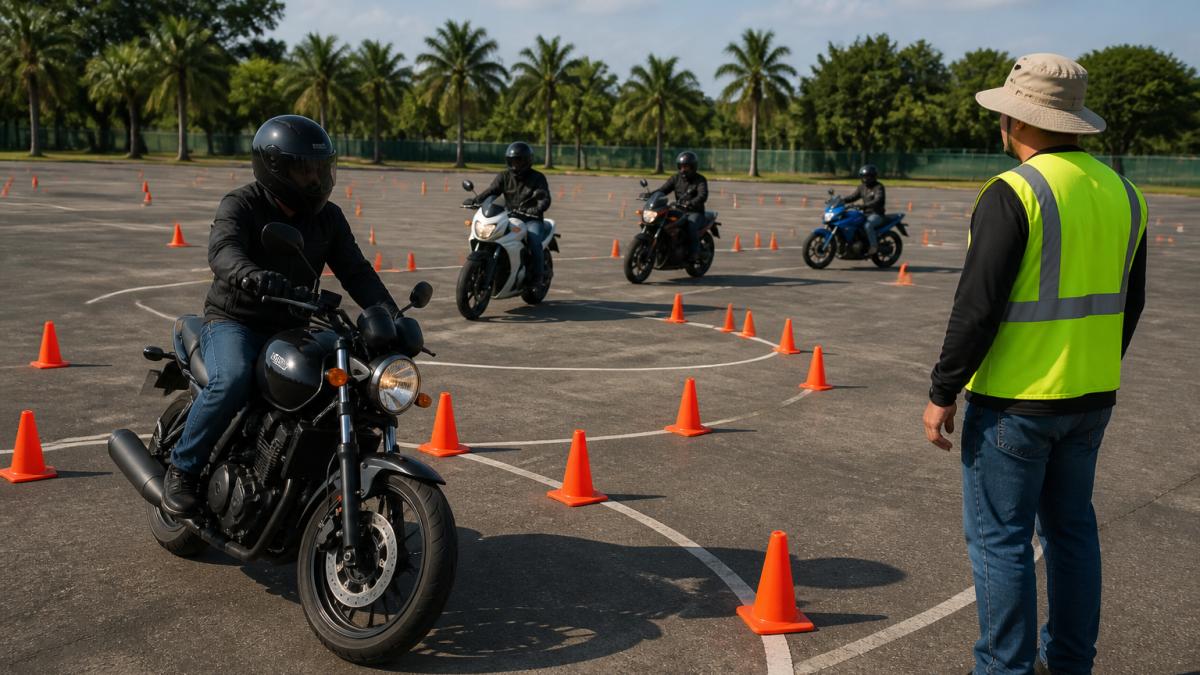
Here's the typical progression:
- Bike familiarization - locating the controls, mounting and dismounting, and walking the bike under power.
- Clutch and friction zone - learning the point where the engine engages so you can start and stop smoothly.
- Straight-line riding and shifting - accelerating, upshifting, downshifting, and braking to a controlled stop.
- Slow-speed control - tight turns, figure-eights, and U-turns that build balance and confidence.
- Cornering technique - leaning, countersteering, and choosing a line through a curve.
- Emergency skills - hard braking and swerving to avoid a hazard without losing control.
- Traffic strategy - lane positioning, following distance, and scanning for danger.
By the end, you should be able to handle a motorcycle through all of these scenarios without panic. That's the standard a certified instructor is looking for, and it's the same standard the state uses to grant your endorsement.
Motorcycle Training Course Gift Cards
A motorcycle training course gift card is a gift that removes the intimidation of getting started. For a friend or family member who's been talking about learning to ride for years, a course enrollment is a far more useful gift than another piece of gear they may never use.
Gift cards work well for several situations:
- A partner or parent who wants to ride but keeps putting it off
- A teenager or young adult ready for their first motorcycle
- An experienced rider getting back into it after years away
- Anyone who needs a nudge to finally book the course
The practical appeal is that it's structured. Unlike a gift card to a general retailer, a training course gift card commits the recipient to a specific, scheduled outcome: earning their endorsement. It's a gift with a finish line.
When buying a gift card, check the fine print: how long it's valid, whether it's transferable, and whether the recipient can reschedule.
Self-Taught vs. Formal Training: Pros and Cons
Formal training wins for the vast majority of new riders, but self-teaching isn't automatically a bad choice. The right path depends on your prior experience, your risk tolerance, and whether your state lets you test without a course.
The self-taught route means practicing on your own bike, often in a parking lot or quiet street, then taking the state riding skills test directly. Its advantages are flexibility. Its disadvantages are significant: no instructor to correct bad habits before they harden, no structured progression, and no insurance discount in most cases. Learning to ride without supervision also means every mistake happens on your own bike, at your own risk.
Formal training offers the opposite trade-off. You get a certified instructor, a controlled environment, a loaner motorcycle so you don't have to own one to learn, and a clear path to your endorsement. The structured curriculum is designed to catch errors early and build correct habits from the first ride.
| Factor | Self-Taught | Formal Training |
|---|---|---|
| Cost | Lower upfront | Higher upfront |
| Structure | None | Full curriculum |
| Instructor feedback | None | Certified coach |
| Bike provided | No | Yes |
| Insurance discount | Rarely | Often |
| Skills test | At DMV | Waived on completion |
| Bad-habit risk | High | Low |
The one scenario where self-teaching makes sense is for a rider with genuine prior experience, perhaps someone who rode dirt bikes for years, in a state that permits direct testing. Even then, a refresher course is usually worth it to unlearn habits that don't translate to street riding.
Motorcycle Safety Foundation rider course overview
Conclusion
The real challenge isn't deciding whether training helps. It's committing to a weekend that will make you a safer, more confident rider for life. At Tampa Motorcycle Training, our MSF-certified Basic Rider Course is built exactly for that: small classes capped at eight students, motorcycles provided for training, and a clear path to your Florida motorcycle endorsement in two days, with no DMV riding skills test required at the end.
Whether you're a complete beginner or an experienced rider getting back on two wheels, our certified instructors meet you where you are. Register now and start riding with the skills and confidence that only proper instruction can give you.
Frequently Asked Questions
How long does it typically take to learn to ride a motorcycle?
Most beginner courses run 15 to 20 hours over two or three days, enough to cover the basics and prepare you for a license test. How long it takes to feel comfortable varies; some riders are ready after one course, while others take extra practice. The key is structured, hands-on time with an instructor who can correct mistakes early.
Is a motorcycle safety course worth the money for beginners?
For most beginners, yes. A course gives you supervised practice on a provided motorcycle, teaches hazard perception and emergency braking, and often lets you skip the DMV riding test. It also may lower your insurance premiums.
How does professional training impact motorcycle insurance rates?
Many insurers offer a discount of 5% to 15% on motorcycle premiums after you complete an approved safety course. The exact amount depends on your provider and state. Even a small discount adds up over a few years, and the skills you gain can help you avoid costly claims.
Do I need to own a motorcycle before taking a training course?
No. Most MSF-certified courses provide motorcycles for the range exercises. You'll need to bring your own helmet (or borrow one), gloves, long pants, and over-the-ankle boots. Check with the school for specific gear requirements before you register.
This article is for general informational purposes. Insurance discounts and licensing requirements vary by state and insurer; confirm current details with your provider and your state licensing agency.