 blog
blog
Motorcycle Riding Lessons in Tampa Bay: 2026 Guide
Table of Contents
- Why Taking a Course Beats Testing at the DMV
- Florida Motorcycle Endorsement Requirements
- Course Options: Two-Wheel, Three-Wheel, and Private Lessons
- Motorcycle License Training Duration: What Two Days Looks Like
- What to Expect During Training
- Beginner Motorcycle Safety Tips
- Pricing, Registration, and Gear
- After the Course: Your Step-by-Step DMV Process
- Frequently Asked Questions
Last Updated: September 25, 2026
Why Taking a Course Beats Testing at the DMV
Florida's motorcycle endorsement process lets you skip the DMV skills test entirely if you complete an approved rider course, the strongest argument for signing up before you ever queue at a counter.
Florida Motorcycle Endorsement Requirements
Florida requires a motorcycle endorsement on your driver license to operate a motorcycle legally on public roads. You must be at least 16, hold a valid driver license or learner's permit, and complete an approved rider training course or pass the state skills test. The endorsement is not a separate license, it's an addition to the credential you already carry.
Motorcycle License vs. Endorsement: What You Actually Need
A motorcycle endorsement is an addition to your existing Florida driver license that permits you to ride a motorcycle. A motorcycle license is a standalone credential issued only to riders who do not hold a regular driver license at all.
Eligibility and Prerequisites
To enroll in a Basic Rider Course, you generally need:
- A valid driver license or learner's permit
- Minimum age of 16 (some providers set their own minimum)
- Closed-toe shoes and basic protective gear
- No prior riding experience required
Course Options: Two-Wheel, Three-Wheel, and Private Lessons
Training programs usually offer three paths, and picking the right one depends on what you plan to ride and how much personal attention you want.
- Two-wheel Basic Rider Course: The standard path for anyone planning to ride a traditional motorcycle. Covers clutch control, braking, and cornering on a provided bike.
- Three-wheel course: Designed for trikes and sidecar rigs. The handling dynamics differ enough that a two-wheel course won't prepare you properly.
- Private lessons: One-on-one instruction for riders who want extra time before a group course, or who are returning after a long break.
Motorcycle License Training Duration: What Two Days Looks Like
Most MSF-certified Basic Rider Courses run two days, mixing online classroom work with on-bike practice. The format is standardized, but the pace surprises first-timers.
Classroom Instruction and the MSF eCourse
The classroom portion is often completed online before you touch a bike. The MSF eCourse covers risk awareness, lane positioning, and traffic strategy, and it's self-paced. It isn't busywork: the scenarios it walks through show up again in the riding exercises, so skipping it means learning theory while everyone else practices.
Riding Exercises and Skills Evaluation
On the range, you'll work through a set sequence of exercises: slow-speed maneuvering, clutch control, braking, cornering, and crash avoidance drills, each building on the last. By the end, you'll complete a skills evaluation that mirrors the DMV test. Pass it, and you've met the riding requirement without ever setting foot in a DMV testing lane.
What to Expect During Training
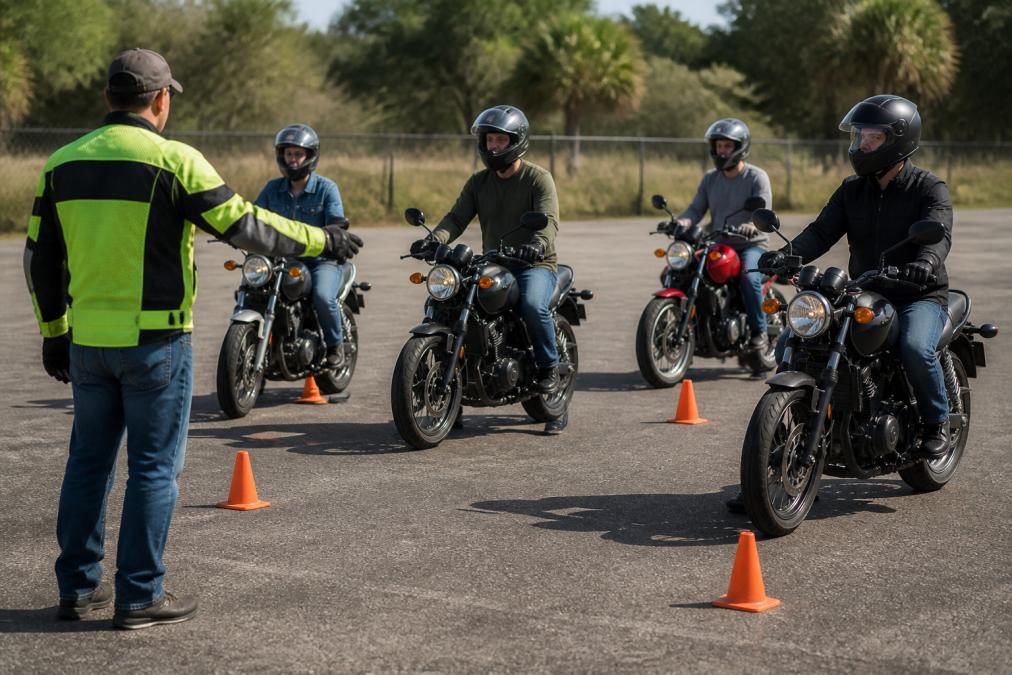
Expect two full days of structured practice, starting with basic bike handling and building toward the skills evaluation. Nervous first-timers are the norm.
Beginner Motorcycle Safety Tips
Safety habits start before the engine does. Riders who stay out of trouble share a few consistent practices.
- Wear a DOT-approved helmet every ride. Florida exempts riders over 21 who carry adequate insurance, but the smart money still wears one.
- Assume you're invisible. Defensive riding means planning for the driver who doesn't see you, not just reacting when they don't.
- Practice slow-speed control. Most drops happen at parking-lot speeds, not highway speeds.
- Check your gear before every ride. Tires, brakes, and lights take thirty seconds to verify.
- Ride within your limits. New riders get hurt pushing past what they've practiced.
Pricing, Registration, and Gear
- Gear rental. Helmets and gloves are usually included. Boots, jackets, and eye protection sometimes are not.
What to confirm before you book:
| Item | What to Check | Why It Matters |
|---|---|---|
| Course type | Two-wheel, three-wheel, or private | Determines which endorsement you qualify for |
| Bike provided | Included or bring your own | Affects cost, insurance exposure, and comfort |
| Class size | Capped or open enrollment | Smaller groups mean more instructor time |
| Completion card | Meets state requirements | Needed to waive the state skills test |
| Retest policy | Free or paid, and how many attempts | Protects you if you need a second try |
| Deposit terms | Refundable, transferable, or forfeited | Determines your downside if plans change |
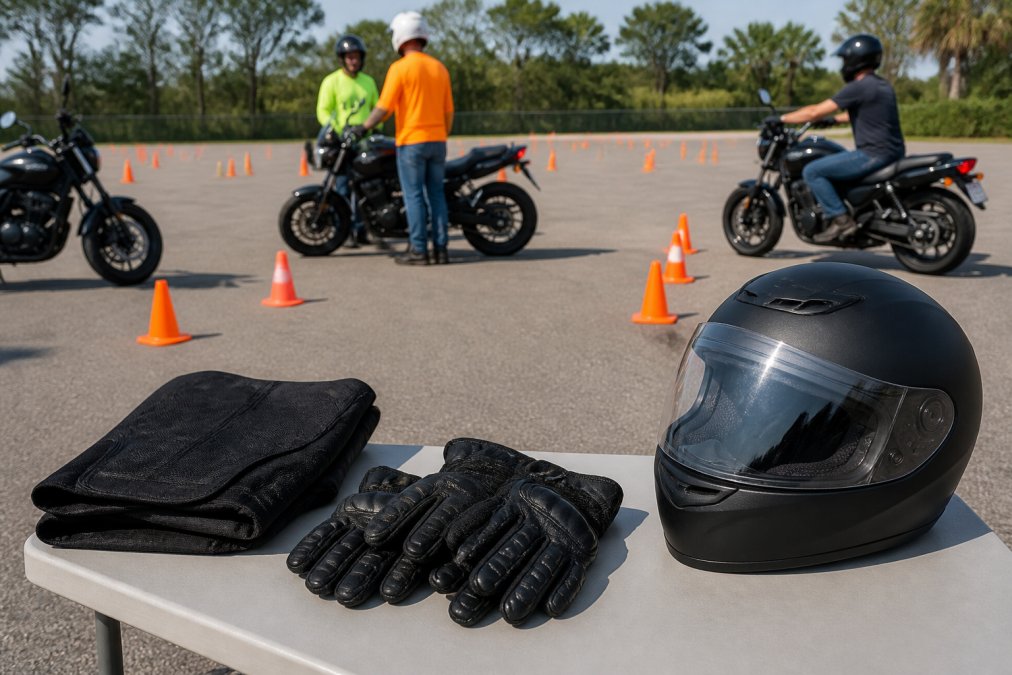
Gear requirements are minimal: closed-toe shoes (over-the-ankle boots preferred), long pants, denim at minimum, no leggings or shorts, eye protection, and full-fingered gloves. Helmets and motorcycles are typically provided. If you ride your own bike to the range, bring a DOT-compliant helmet and confirm riding in is permitted. Proper preparation extends beyond personal attire to the mechanical readiness of your machine, as consistent motorcycle drivetrain maintenance ensures that your bike remains reliable throughout the rigorous training exercises.
After the Course: Your Step-by-Step DMV Process
Finishing the course does not automatically add the endorsement to your license. You still have to file paperwork in person, and the order matters.
- Receive your completion card. Your provider issues documentation proving you passed an approved course. Keep the physical card, a photo on your phone is not accepted at the counter.
- Gather your documents. Bring your current driver license or learner's permit, the completion card, proof of identity, and proof of your Social Security number if it isn't already on file with the state.
- Go to a driver license office. In most counties, this means a Tax Collector's office that handles driver license services, not a stand-alone DMV branch. Check which office near you issues and amends licenses before you drive over.
- Pay the endorsement fee. The state charges a motorcycle endorsement fee on top of the standard license transaction, and county offices may add a service fee. Bring a card and a backup form of payment; some offices are cashless.
- Receive your updated license. Your new card arrives with the motorcycle endorsement coded on it. You'll often get a paper interim document to ride on until the plastic card arrives by mail.
A few things that trip people up:
- The completion card is not the endorsement. It waives the state skills test but does not grant riding privileges on its own.
- You cannot add the endorsement online. The transaction requires an in-person visit to verify your completion card and update your photo record.
- Bring your own helmet if you want to ride home. The state does not lend you one, and the office won't let you leave on a bike without a DOT-compliant helmet if you're under 21 or riding without the medical insurance exemption.
- Name mismatches cause delays. If your completion card shows a different name than your driver license, a maiden name, a hyphen, a middle initial, fix it with the school before you go to the counter.
What Comes After the Endorsement
The two-day timeline sounds aggressive to anyone who has never ridden. It works because the curriculum is built around repetition, not theory: you practice the exact skills you'll be tested on, with an instructor correcting you in real time. That's the advantage over studying alone, and the reason the endorsement is the beginning of your education, not the end.
Frequently Asked Questions
How long does it take to get a motorcycle endorsement in Florida?
Most riders finish in about two days. The Basic Rider Course runs roughly 15 hours across a weekend or two weekdays, combining classroom instruction and riding exercises. After you pass, you take your completion card to a Florida DMV or tax collector office and add the endorsement to your license, which usually takes one visit. You can also complete the written test through the MSF eCourse before class, so you arrive ready to ride.
Do I need my own motorcycle to take riding lessons?
No. Tampa Motorcycle Training provides motorcycles for every student in the Basic Rider Course, so you do not need to own or borrow a bike to start. This is one of the biggest advantages for beginners, since you learn clutch control, braking techniques, and slow maneuver techniques on a training bike before deciding what to buy. If you already own a motorcycle, you can still use the provided bikes and save your own for practice after class.
Are motorcycle riding lessons required to get a license in Florida?
Florida requires riders under 18 to complete an approved rider education course before getting an endorsement. Riders 18 and older can technically test at the DMV, but completing an MSF-certified Basic Rider Course earns a DMV test exemption, meaning you skip the riding skills test entirely. Most Tampa Bay riders choose the course because it is faster, safer, and gives you supervised practice on real motorcycles before you ride on public roads.
What happens if I do not feel ready to pass after the course?
Ask about the provider's retake policy before you register. Many MSF-certified courses offer a second chance or coaching session if a student needs more practice, though details vary by school. Instructors watch your progress through the skills evaluation and will tell you honestly whether you are ready. If nerves are the issue, a private lesson or an extra range session can help you build confidence before retesting.
The real challenge isn't passing a test. It's building the habits that keep you safe for years after. Tampa Motorcycle Training runs an MSF-certified Basic Rider Course with class sizes capped at eight students, motorcycles provided for training, and the MSF eCourse included. Complete the course and you can skip the DMV riding skills test entirely. Get started with Tampa Motorcycle Training and earn your Florida motorcycle endorsement in two days.