 how-to
Motorcycle Riding Test Tips for Beginners: 2026 Guide
Table of Contents
- What You'll Need Before Test Day
- Motorcycle Skills Test Practice Drills That Build Real Control
- Step-by-Step Walkthrough of the Riding Test Course
- Common Motorcycle License Test Mistakes Beginners Make
- MSF Basic Rider Course Requirements and What to Expect
- How to Prepare for the Motorcycle Riding Test: A Weekly Plan
- Conclusion: Ride Confident on Test Day
- Frequently Asked Questions
Last Updated: October 7, 2026
What You'll Need Before Test Day
A motorcycle riding test rewards preparation more than talent. At Tampa Motorcycle Training, we've watched hundreds of new riders walk into their skills test nervous and walk out with a passing score, and the difference almost always comes down to what they did in the weeks before. This guide covers the motorcycle riding test tips beginners actually need: the drills, the course, the mistakes, and the paperwork.
In Florida, riders under 18 must complete a state-approved Basic Rider Course before getting an endorsement. Riders 18 and older can choose between the state course or the DMV skills test. Most beginners who take the course route skip the DMV riding skills test entirely. That's the path we recommend, and it's the one we teach.
Motorcycle Eligibility and Gear Requirements
Before you book anything, confirm your motorcycle qualifies. The bike must be street-legal, insured, registered, and pass a basic safety check. You'll also need to show a valid driver's license or learner's permit.
Your gear matters just as much. Bring:
- A DOT-approved helmet
- Eye protection (goggles or a face shield)
- Long sleeves and long pants
- Full-finger gloves
- Over-the-ankle boots
No exceptions on the helmet. Show up without one and you won't test.
Documents and Test-Day Logistics
Arrive early. Bring your license, proof of insurance, and your course completion card if you took a rider course. Expect a wait, a paperwork check, and a short briefing before you ride.
The Florida Department of Highway Safety and Motor Vehicles rider handbook spells out the exact documents your county office requires. Read it before you go.
Motorcycle Skills Test Practice Drills That Build Real Control
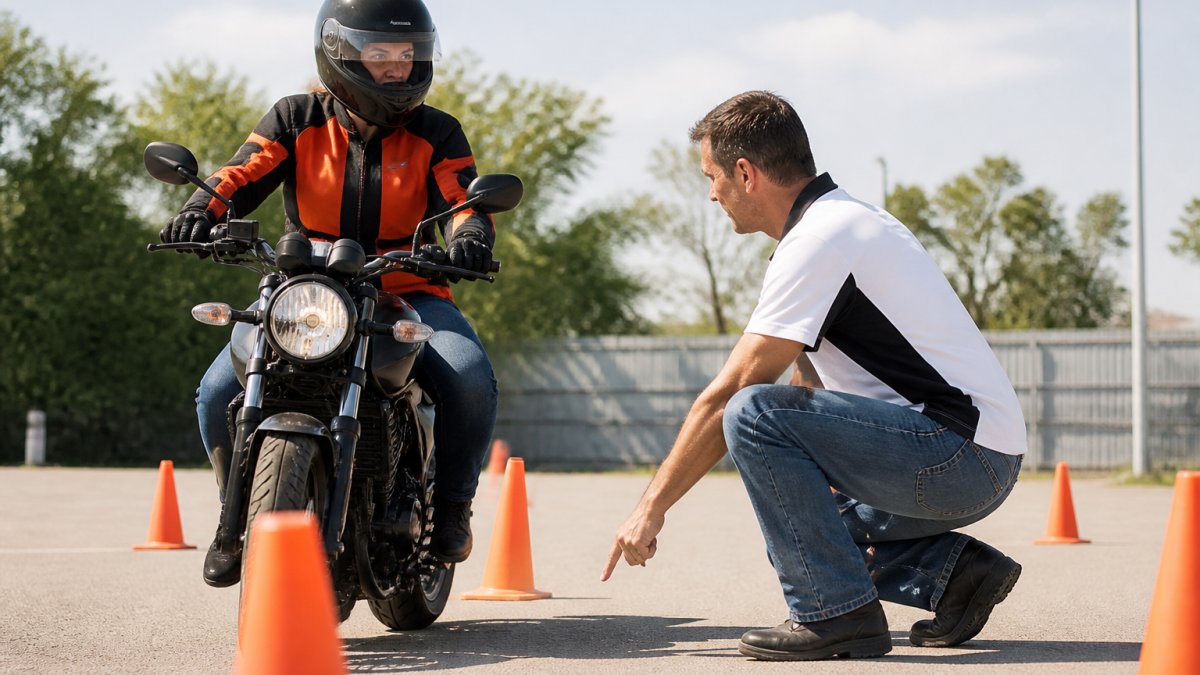
Practice drills turn nervous beginners into confident riders. The skills test measures control at low speed, not speed. Spend your practice time in an empty parking lot, not on the highway.
Before each session, run a pre-ride inspection: tire pressure and tread, brake feel, lights and turn signals, fluid leaks, and chain tension. A bike that fails inspection fails the test, and a soft tire will quietly ruin your cone weave.
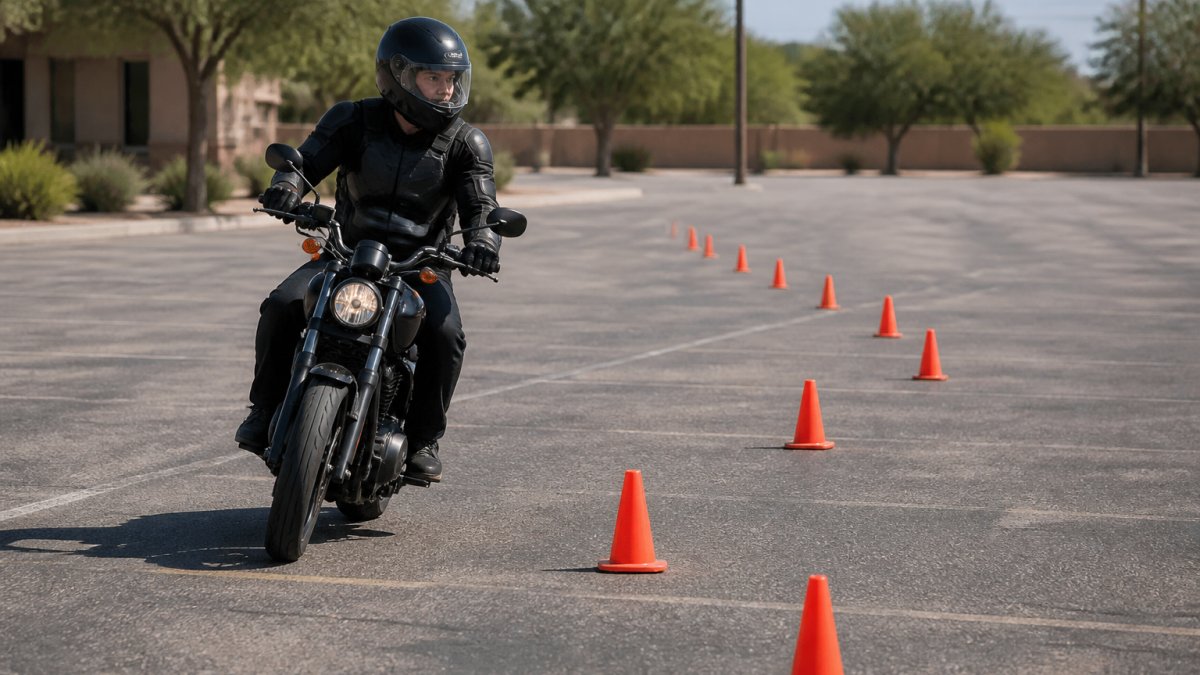
Cone Weave Drill
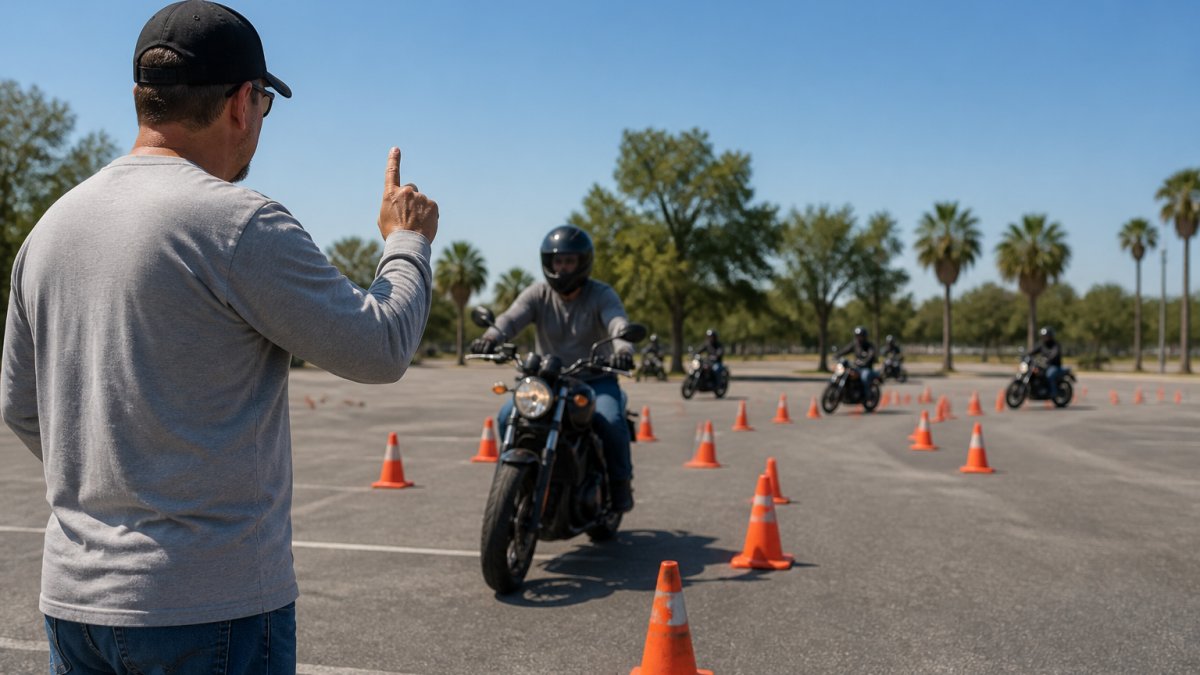
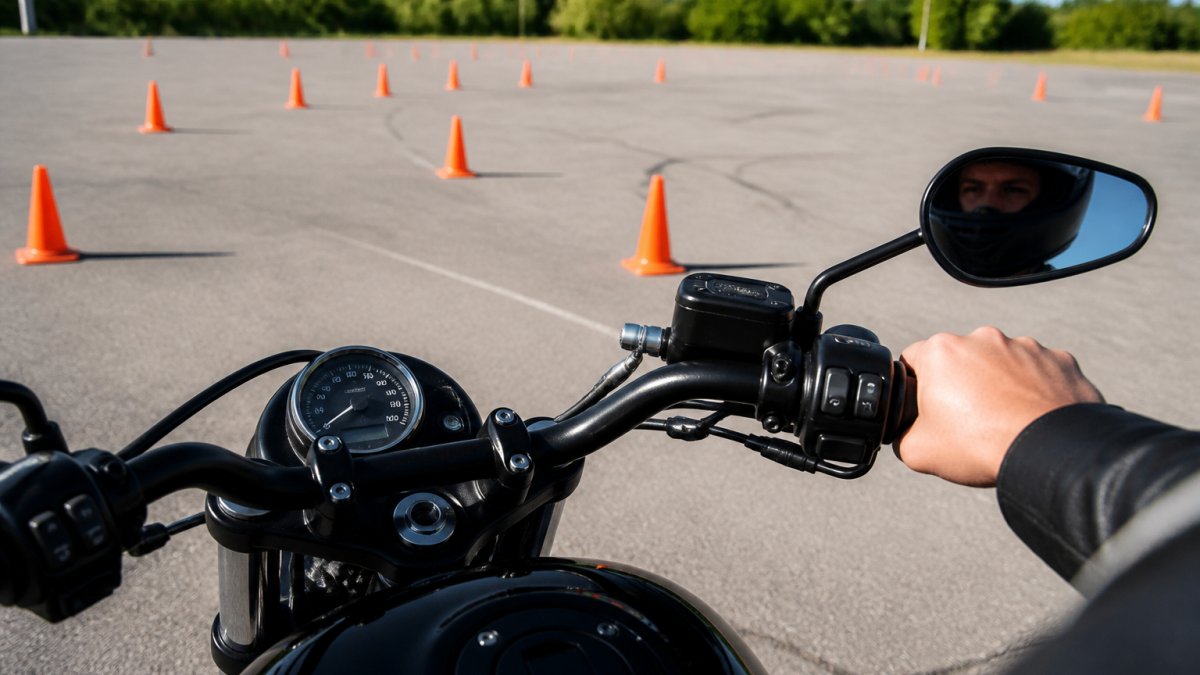
Set up five cones in a straight line, about 12 feet apart. Ride through them at a walking pace, using your clutch and throttle to stay steady. This drill builds the low-speed maneuvering the test demands.
Execution cues:
- Keep your eyes two to three cones ahead, never on the cone beside your front wheel.
- Hold a light, constant throttle and control speed with the clutch in the friction zone.
- Let the bike lean; do not steer with your arms alone.
- Keep your feet on the pegs the entire run.
Run each drill for 10 minutes. Repeat three times per session.
U-Turn Drill
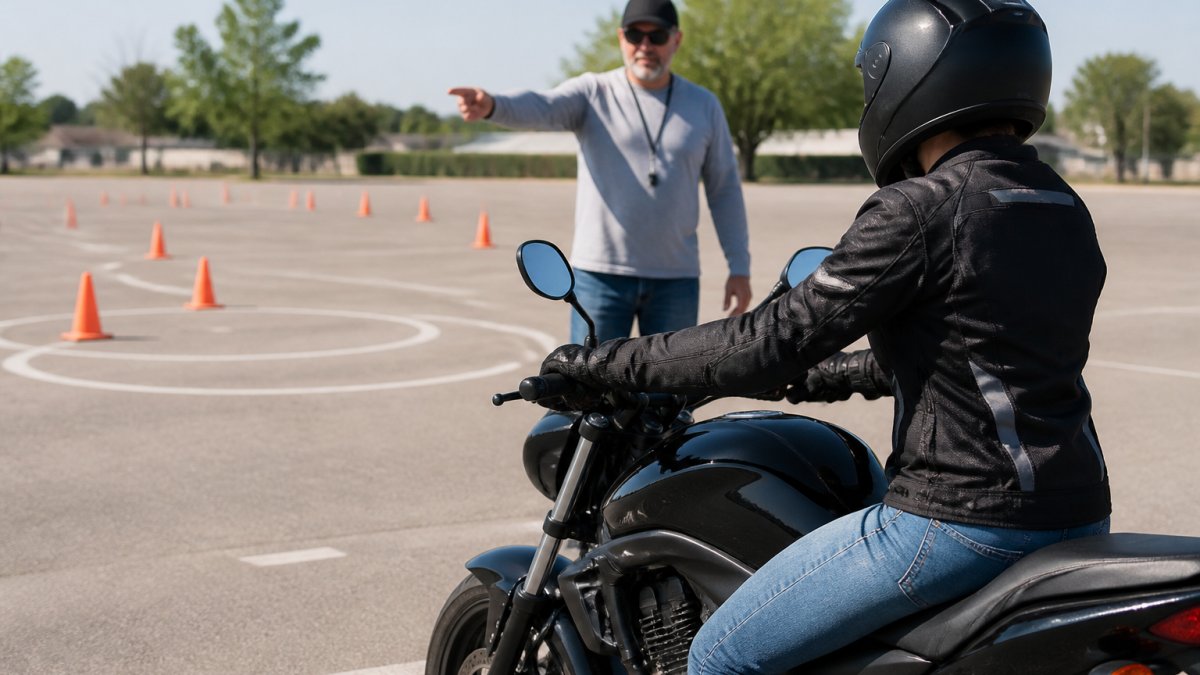
Mark a box about 20 feet wide. Practice turning inside it without putting a foot down.
Execution cues:
- Look over your shoulder toward the exit of the turn, not at the ground.
- Drag the rear brake lightly to stabilize the bike at low speed.
- Stay in the friction zone so the engine keeps pulling.
- Lean the bike while keeping your upper body more upright.
Obstacle Swerve Drill
Place two markers roughly 8 to 10 feet apart and practice swerving between them while keeping your speed controlled. Approach at a steady speed, push the bars to initiate the lean, then straighten and re-center.
Execution cues:
- Swerve, then recover, do not brake mid-swerve.
- Keep your head up and your grip relaxed.
- Practice swerving both left and right so neither direction feels new on test day.
Braking and Controlled Stop Practice
Find a straight stretch of pavement. Accelerate to about 15 mph, then brake smoothly to a full stop. Do this 10 times. The goal is a controlled stop, not a skid.
Execution cues:
- Squeeze the front brake progressively; use both brakes together.
- Keep the bike straight and the bars square during the stop.
- Put your left foot down first when you come to rest.
Practice the 12-second following distance on the road too. It keeps you aware of your braking distance and hazard avoidance.
Beginner Troubleshooting
Most practice sessions stall on the same four problems. Here is how to fix them:
- Stalling at low speed: You are dropping the clutch too fast or letting the throttle fall off. Add a little throttle and release the clutch more slowly through the friction zone.
- Putting a foot down in the U-turn: You are looking down. Pick your head up and look at where you want to exit the turn.
- Target fixation: Staring at the cone or boundary you want to avoid guarantees you hit it. Force your eyes to the path around it.
- Clutch-throttle coordination: Practice the friction zone with the bike stopped, slowly release the clutch until the bike just begins to creep, then pull it back in. Repeat until the engagement point feels automatic.
Readiness Check
You are ready to test when you can complete every maneuver twice in a row without a foot down, a boundary line, or a stall. If any drill still feels shaky, add one more session before you book.
Step-by-Step Walkthrough of the Riding Test Course
The test course is a sequence of maneuvers, not a race. Most skills tests follow the same pattern: a cone weave, a normal stop, a sharp turn, a U-turn, and a swerve.
Here's how a typical run looks:
- Enter the course and complete the cone weave
- Ride to the normal stop box and stop smoothly
- Make a sharp turn within the marked boundary
- Complete a U-turn inside the box
- Swerve around the obstacle marker
- Accelerate and brake to a controlled stop
Each maneuver is scored on control, not speed. Put a foot down during the U-turn and you lose points. Cross a boundary line and you lose points. Stay smooth and you pass.
The Motorcycle Safety Foundation rider course overview describes the same skills the test measures, which is why the course prepares you so well.
Common Motorcycle License Test Mistakes Beginners Make
Most failures come from nerves, not lack of skill. Riders rush the clutch, look down at the front wheel, or tense up on the bars. All three break your balance.
The biggest fix is simple: look where you want to go. Your bike follows your eyes. Stare at the cone you're trying to avoid and you'll hit it.
How the Test Is Actually Scored
Examiners score each maneuver on control, not speed. You accumulate points for errors, and the pass threshold is a maximum number of points, so a single sloppy maneuver does not necessarily fail you, but several small ones add up. Typical deductions include:
- Putting a foot down during a maneuver
- Crossing or touching a boundary line
- Stalling the engine
- Missing or skipping a required maneuver
- Riding too slowly or too fast for the maneuver
Because points accumulate, the smart strategy is to ride every maneuver cleanly rather than to ride one perfectly and rush the rest. Ask your test site for its scoring sheet before test day so you know exactly what is being counted.
Common Mistakes and How to Fix Them
- Riding too fast through the cone weave: Slow down and control speed with the clutch, not the brake.
- Forgetting to cancel the turn signal: Build the habit of canceling the signal every time you complete a turn, even in practice.
- Putting a foot down during the U-turn: Look at your exit point, not the ground, and drag the rear brake for stability.
- Braking too hard and locking a wheel: Squeeze the front brake progressively and use both brakes together.
- Tensing up on the bars: Loosen your grip and breathe. A tight grip transmits every wobble into the steering.
Automatic-Fail Errors to Avoid
Some mistakes end the test immediately. Know them before you ride.
- Dropping the motorcycle
- Stalling more than twice
- Leaving the course boundary
- Skipping a required maneuver
- Riding without a helmet or required gear
Avoid these and you're already ahead of most first-timers.
MSF Basic Rider Course Requirements and What to Expect
The MSF Basic Rider Course is the fastest path to a Florida motorcycle endorsement. It combines an online eCourse with two days of hands-on riding. You'll practice every maneuver the skills test measures, on a motorcycle we provide.
Requirements are simple:
- Be at least 16 years old
- Have a valid driver's license or permit
- Bring proper riding gear
- Complete the eCourse before your first riding day
Class sizes stay small, capped at eight students, so instructors can give real feedback. Most riders finish feeling ready, not rushed. Complete the course and you skip the DMV riding skills test entirely.
Our Florida Rider Training Program approved Basic Rider Course covers everything from motorcycle controls to road awareness. You can register here when you're ready.
How to Prepare for the Motorcycle Riding Test: A Weekly Plan
A four-week plan beats cramming. Here's how we'd structure it.
| Week | Focus | Practice Time | Goal |
|---|---|---|---|
| 1 | Controls and friction zone | 3 x 20 min | Smooth starts and stops |
| 2 | Cone weave and U-turn | 3 x 30 min | No foot down |
| 3 | Braking and swerve | 3 x 30 min | Controlled stop every time |
| 4 | Full course run-throughs | 4 x 30 min | Pass every maneuver |
Start each session with a pre-ride inspection: tire pressure, tread depth, brakes, lights, turn signals, fluid leaks, and chain tension. A bike that fails inspection fails the test.
Track your progress. If you can complete every maneuver twice in a row without a foot down or a boundary line, you're ready.
Conclusion: Ride Confident on Test Day
Test-day nerves are normal, but they don't have to run the show. Riders who prepare with real drills, learn the course, and know the automatic-fail errors walk in calm and walk out with an endorsement.
At Tampa Motorcycle Training, our MSF-certified Basic Rider Course gets you there in two days. Small classes capped at eight students mean hands-on coaching, motorcycles are provided, and you skip the DMV riding skills test when you finish. No prior experience needed.
Get started with Tampa Motorcycle Training and earn your Florida motorcycle endorsement with confidence.
Frequently Asked Questions
What are common motorcycle test mistakes?
The most frequent mistakes include putting a foot down during low-speed maneuvers, braking too hard in a corner, and failing to check mirrors before changing lanes. Riders also lose points for stalling the engine, crossing cone boundaries during the weave, and not completing the controlled stop within the required distance. Practicing the exact skills test exercises in a parking lot before test day helps eliminate these errors.
What is the 12 second rule on a motorcycle?
The 12-second rule refers to maintaining a following distance of at least 12 seconds behind the vehicle ahead when riding. This gives you enough time to react to sudden stops, road hazards, or changing traffic conditions. During the motorcycle riding test, examiners watch for proper spacing and awareness. In practice, pick a fixed object ahead and count how long it takes to reach it after the car in front passes it.
Is a motorcycle test hard to pass?
The test is challenging for riders who have not practiced low-speed control, but it is very passable with preparation. Most failures come from nerves and unfamiliarity with the test course, not lack of skill. Completing an MSF Basic Rider Course or spending several hours on practice drills like the cone weave and U-turn dramatically improves your odds. Beginners who practice consistently typically pass on their first attempt.
How do I prepare for the motorcycle skills evaluation?
Start with a structured practice plan at least two weeks before your test date. Focus on low-speed maneuvering, controlled stops, and the cone weave. Ride in an empty parking lot to simulate the test course. Review the specific scoring criteria for your state so you know which errors cause automatic failure. If you are nervous, an MSF-certified course provides professional instruction and often lets you skip the DMV skills test entirely.